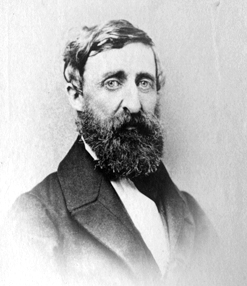
The Many Lives of Henry David Thoreau
Writer, social reformer, naturalist, philosopher, Transcendentalist, scientist. These are just some of the terms by which Henry David Thoreau can be categorized. It is perhaps the many “lives” of Thoreau, both individually and collectively, that beckon such a diversity of people to his writings.
Henry David Thoreau was born on July 12, 1817, in Concord, Massachusetts. Thoreau was the second son in a family of four children, which included his brother John, Jr., and his sisters, Sophia and Helen.
Although only a small part of his work was published in his short lifetime, he was a prolific writer whose collected works filled twenty volumes when compiled in 1906. That Thoreau was the first American author to have his voluminous two million word journal published in full speaks to the recognition his publisher Houghton Mifflin accorded his work.
As a young adult, Thoreau was drawn to social reform because he struggled with the consequences of a country rapidly altered by industrialization and the expansion of the railroads. As an abolitionist, he could not condone the actions of a government that refused to acknowledge the injustices of systemic slavery. Thoreau’s writings reflect these concerns and are as relevant today as they were in nineteenth-century America. Thoreau’s, Civil Disobedience, influenced Gandhi’s work in India, Tolstoy’s philosophy in Russia, and Dr. King’s civil rights stand in the United States. Thoreau wrote, “Can there not be a government in which the majorities do not virtually decide right and wrong, but conscience? . . . Must the citizen ever for a moment, or in the least degree, resign his conscience to the legislator? Why has every man a conscience, then?”
Thoreau is often remembered for the two years, two months, and two days he spent living on the outskirts of Concord in a small house he built near Walden Pond. A decade later, in Walden, he wrote about that experience in a text that has been published in nearly every known language. As a naturalist, Thoreau understood that the path to a greater understanding of our life on earth is through an understanding of the natural world around us and of which we are a part. “We can never have enough of nature,” Thoreau asserted in Walden.
As a philosopher and Transcendentalist, Thoreau found a pantheistic sense of spirit and God: “I do not prefer one religion or philosophy to another. I have no sympathy with the bigotry and ignorance which make transient and partial and puerile distinctions between one man’s faith or form of faith & another’s . . . To the philosopher all sects, all nations, are alike. I like Brahma, Hari, Buddha, the Great Spirit, as well as God.” His contemporaries and friends in the Transcendentalist movement included Nathaniel Hawthorne, Bronson Alcott, Margaret Fuller, and his mentor, Ralph Waldo Emerson.
As a scientist, Thoreau embraced the controversial work of Darwin and developed theories of forest succession at the same time one of Harvard’s leading naturalists, Louis Agassiz, was still touting the spontaneous generation of plants. Thoreau was able to praise the scientific method — “Science is always brave, for to know, is to know good; doubt and danger quail before her eye.” — while accepting its limitations: “With all your science can you tell how it is — & whence it is, that light comes into the soul?”
Thoreau died on May 6, 1862. Ralph Waldo Emerson wrote in his eulogy: “The country knows not yet, or in the least part, how great a son it has lost. . . . His soul was made for the noblest society; he had in a short life exhausted the capabilities of this world; wherever there is knowledge, wherever there is virtue, wherever there is beauty, he will find a home.”
More about Thoreau
Thoreau’s Writings
A note on pronouncing the name Thoreau
In determining the way in which to pronounce his name, it seems best to bow to the authority of those who knew Thoreau well. Edward Emerson, the son of Ralph Waldo Emerson, is very clear. In a letter to Dr. Loring Holmes Dodd, October 11, 1918, he wrote: “We always called my friend Thó-row, the h sounded, and accent on the first syllable.” [The Goddard Biblio Log, Spring 1973, p. 7]